
About this article: HomFax™ is a trademark of the Ambassador Claim Handling System and a trading name of Regulus Development Company. Public adjusting services, where provided, are performed by Octavian Payne-Johnson, Texas public insurance adjuster licence #3277221. HomFax is paid for inspection, documentation, estimating, verification and licensing of its technology. We are not paid a percentage of any insurance settlement, and our compensation does not change with the outcome of a claim — we are paid the same whether a property turns out to have no covered damage or a great deal of it. This article is general education for property owners. It is not advice about your specific policy or claim, and reading it does not make you a client.
Two companies rated your home's risk. They didn't agree.
Property risk scores are presented as facts. When researchers got two of the companies that produce them to compare notes, their rankings of the same houses barely lined up.
By HomFax™ — homeowner education for North Texas · 2026-08-25
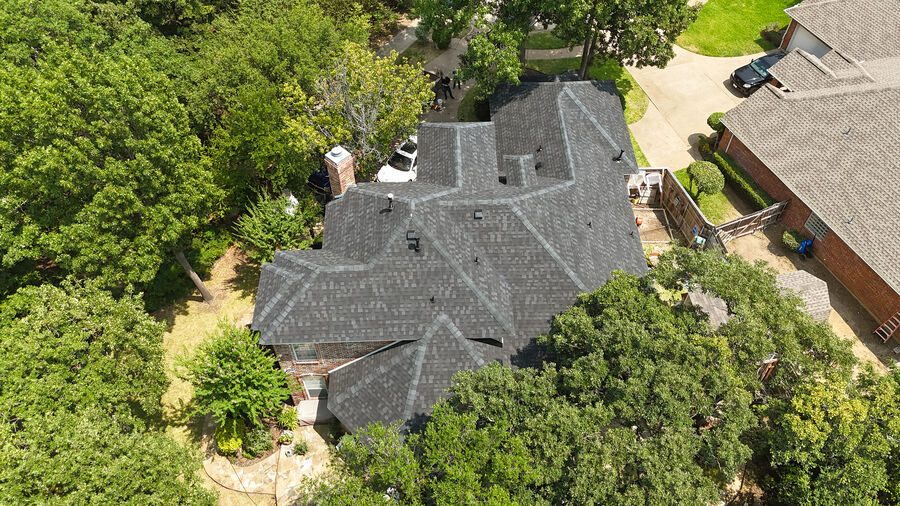
You have probably seen a number attached to your house.
A flood factor on the listing. A wildfire score in a real estate app. A line in a letter from your carrier explaining that your area has been reassessed. The number arrives without a margin of error, formatted like a fact — 4 out of 10, moderate, elevated.
Here is what almost nobody tells you about that number.
Researchers asked nine companies to compare notes. Two said yes.
In a study by CarbonPlan, a nonprofit that analyzes climate data, nine commercial risk-modeling companies were invited to submit their property-level scores for the same set of addresses so the results could be compared side by side.
Two agreed: Jupiter Intelligence and XDI.
Four declined outright — Verisk, First Street, ClimateCheck and Zesty.ai. Three never responded.
That is worth sitting with before we get to the numbers. Seven of nine companies that sell risk scores about your house would not let anyone check their scores against a competitor's.
Where comparison was possible, the scores did not line up
The two participating companies rated the same properties. Researchers then measured how closely their rankings matched, using a standard statistic called Kendall's tau. A score of 1.0 means the two companies ranked every property in identical order. A score of 0 means their rankings have no relationship at all.
| What was rated | How closely they agreed |
|---|---|
| Riverine flooding, 124 New York State properties | 0.19 |
| Wildfire, 128 California properties | 0.25 |
| Coastal flooding, 90 New York City properties | 0.55 |
Translated out of statistics: on flood risk, if you handed both companies two houses and asked which one is riskier, they would give you the same answer about 60% of the time. A coin flip gets you 50%.
On the long-range wildfire projections, the two companies agreed that risk was increasing at only 12% of the locations they both looked at.
What this does not mean
It does not mean the models are junk, and we are not going to tell you that.
The companies agreed substantially on which regions are risky. Broad geographic signal is real, it is based on genuine science, and it is useful. If a model says your county has a serious hail exposure, that is worth taking seriously.
The disagreement shows up when you zoom in to a single address. Regional accuracy and address-level accuracy are different things, and the products are sold at the address level.
Why this matters more than it did five years ago
Two things changed at once.
Carriers are dropping more policies. The National Association of Insurance Commissioners studied 715 companies writing homeowners coverage and found that company-initiated non-renewals rose between 96% and 216% depending on the region, between 2018 and 2024. In the West, non-renewals per 1,000 policies more than tripled.
The public scorekeeper went quiet. For decades, NOAA maintained the federal record of billion-dollar weather disasters — the neutral benchmark everyone argued from. NOAA retired it in May 2025 with no updates past 2024. A nonprofit, Climate Central, picked up the work in July 2025 and still maintains it. But the authoritative version now depends on private funding rather than a federal mandate.
So: more properties are being reassessed, on models that disagree with each other at the address level, with a thinner public record to check them against.
The part you can actually control
You cannot audit a model. You can document your own property.
A modeled score is a prediction made from a distance — satellite data, terrain, regional loss history, an estimate of what your roof probably is. A physical inspection is a record of what is actually there on a specific date. When those two things conflict, the documented record is the one with evidence behind it.
Practical steps, none of which require hiring anyone:
- Photograph your roof and exterior now, while nothing is wrong. Date-stamped. A "before" record is worth far more than a description written after a storm.
- Keep your own file. Age of roof, material, any repairs, permits pulled, receipts. Carriers ask; owners who can answer immediately are treated differently than owners who cannot.
- Ask your agent what data they use. You are allowed to ask which model or vendor informed a rate change or a non-renewal, and whether the property-specific details on file are correct. Sometimes they are not — wrong roof age and wrong roof material are common and both are fixable.
- Correct the record before you need it. Fixing an error on a quiet Tuesday is a phone call. Fixing it during a claim is a much longer conversation.
Where we fit
HomFax inspects properties and documents their condition. We photograph, measure, and record what is physically there, and we give you that record.
We do not adjust insurance claims, negotiate with carriers on your behalf, or interpret what your policy covers. Texas law reserves that work for licensed public adjusters and attorneys, and there are good reasons for it. What we produce is evidence about your property. What you do with it is your decision.
If a model that has never been to your house says one thing and a dated inspection says another, we think you should be the one holding the inspection.
- CarbonPlan — Climate risk companies don't always agree
- NAIC — First-of-its-kind national homeowners market analysis, 715 carriers, 2018–2024
- US Treasury, Federal Insurance Office — Homeowners insurance market report, January 2025
- NOAA NESDIS — Notice retiring the Billion-Dollar Weather and Climate Disasters product, 8 May 2025
- Climate Central — Billion-Dollar Weather and Climate Disasters, stewardship assumed 28 July 2025
Every factual claim above traces to one of these. Check them rather than taking our word for it.